Series: nguoi-cua-to-chuc · Part 11
Engineering Leadership
Mrs. Tu's File Goes Around the World
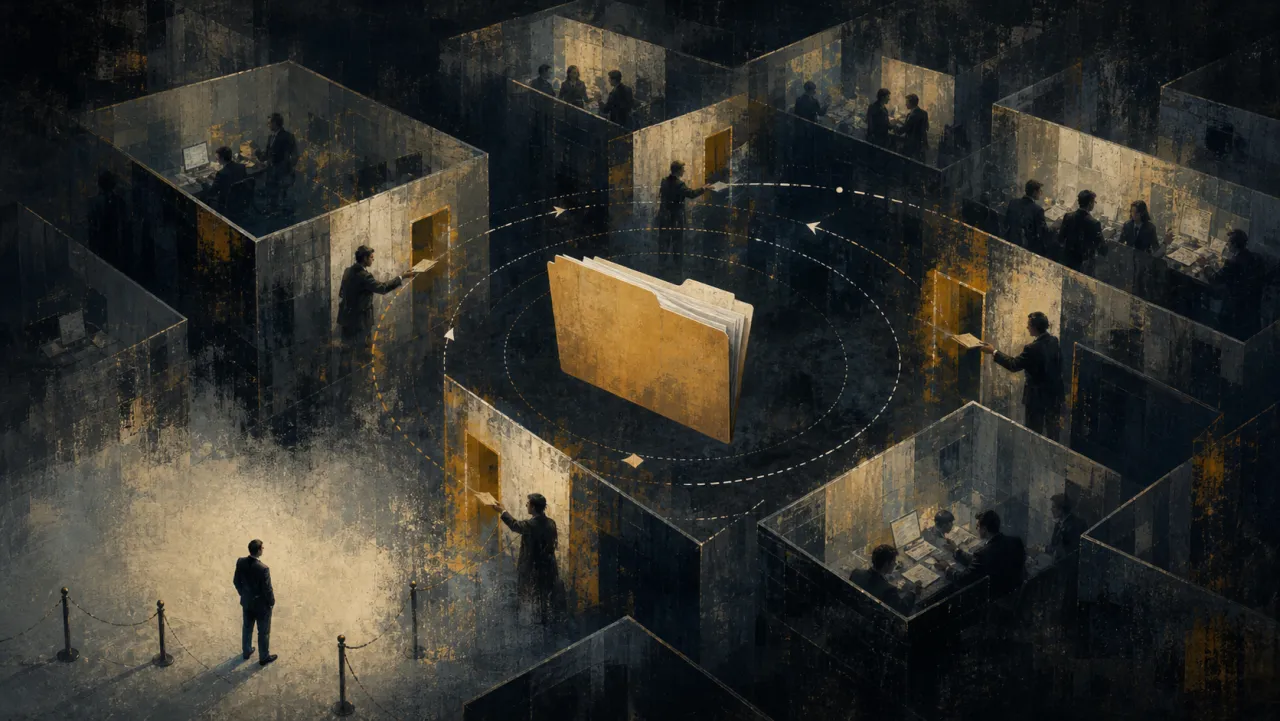
A file travels farther than anyone intended.
2026-06-246 min read
- 0.The Job Nobody Can Name
- 2.The Immortal Spreadsheet
- 3.The Greenest Dashboard in History
- 4.The Person Who Keeps Asking What If
- 5.The 36-Month Roadmap and Monday Morning
- 6.The Wall Nobody Is Allowed to Touch
- 7.Truth Needs a Singapore Passport
- 8.Creating an Office to Eliminate Offices
- 9.The Perfectly Straight Timeline
- 10.Four Bosses, Four T-Shirts
- 11.Mrs. Tu's File Goes Around the World(this post)
Mrs. Tu's file began at a branch counter on a rainy Tuesday.
It should have been simple. A customer needed an update, the branch collected the documents, and the request entered the system. The branch officer smiled, stamped what needed stamping, and told Mrs. Tu she would receive a response soon.
The file then began its journey around the organization.
First it went to Operations.
Operations checked the documents and found one field inconsistent with the old record. They returned it to the branch with a note: "Please verify customer information."
This was correct.
The branch called Mrs. Tu, confirmed the information, and resubmitted.
The file went to Risk.
Risk saw that the updated information triggered a policy condition. They requested supporting evidence.
This was also correct.
Mrs. Tu brought the evidence. The branch scanned it. The file moved again.
This time Compliance reviewed it.
Compliance noted that the evidence format had changed under a recent guideline. They asked whether the branch had used the latest checklist.
Correct again.
The branch had used the checklist printed last month. The latest checklist had been uploaded three days earlier to a folder nobody in the branch knew existed.
The file returned.
By then, Mrs. Tu had visited the branch three times. Each time, someone apologized sincerely. Each time, the system showed a different status. Each status was meaningful to the organization and useless to Mrs. Tu.
"Pending verification."
"Awaiting risk review."
"Returned for compliance clarification."
To the customer, all of them meant the same thing: not done.
Nhan became aware of the file because it appeared in a customer complaint report. He traced its path and found no villain.
That was what made it depressing.
Every department had followed its process. Every note was defensible. Every request had a rationale. Nobody had ignored Mrs. Tu. Nobody had been lazy. Nobody had maliciously delayed the case.
The file had suffered from too much correctness.
In the meeting, each department explained its role.
Operations: "We cannot process inconsistent data."
Risk: "We cannot waive evidence requirements."
Compliance: "We cannot accept outdated checklist versions."
Branch: "We cannot ask the customer to come back forever."
Everyone was right.
This is how silos survive: not through bad intentions, but through local correctness.
Each team optimizes for the risk it owns. The customer experiences the sum of risks nobody owns.
Nhan asked who owned the end-to-end journey.
The room discussed this for twenty minutes and produced three possible owners, all conditional.
If it was a data issue, Operations.
If it was a policy exception, Risk.
If it was communication, Branch.
If it was regulatory interpretation, Compliance.
If it was customer experience, everyone.
"Everyone" is a beautiful word until action is required.
Mrs. Tu's file kept moving.
At one point, it was escalated to a cross-functional channel. The channel had representatives from every department and no single person with authority to decide. People responded quickly. They asked good questions. The thread grew longer. The file remained unresolved.
Nhan printed the timeline and placed it on his desk. It looked like a map of a small country at war with itself.
The breakthrough came from a branch supervisor who asked a rude question.
"Can one person just call all the departments and decide?"
There was silence.
The suggestion was operationally crude, politically inelegant, and exactly what was needed.
A temporary case owner was assigned. She called Operations, Risk, Compliance, and the branch in one afternoon. She made trade-offs in the open. She documented the exception. She called Mrs. Tu herself.
The case closed the next day.
In the post-mortem, the organization described the fix as an "end-to-end ownership mechanism." This sounded much better than "one competent person picked up the phone."
Nhan did not mind. Sometimes the formal name helps the informal truth survive.
Later, he looked again at the journey map. The process was not broken at any single point. It was broken between points.
That is where customers live.
Not inside Operations. Not inside Risk. Not inside Compliance. Not inside a branch workflow. Customers live in the handoffs, the waiting, the re-explaining, the spaces where every department is technically right and the customer is practically abandoned.
Mrs. Tu eventually received what she needed. She did not know her file had taught the organization a lesson. She only knew it had taken too long.
That was fair.
Customers do not owe organizations appreciation for finally solving problems the organization created.
Nhan kept the printed timeline for a while. Not as evidence of failure, but as a reminder.
When everyone is right in their own box, someone has to be responsible for the space between boxes.
Otherwise the file keeps traveling, and the customer becomes the only person who cannot leave the journey.