Series: nguoi-cua-to-chuc · Part 10
Engineering Leadership
Four Bosses, Four T-Shirts
Strategies change shirts. The office learns what to keep.
2026-06-244 min read
- 0.The Job Nobody Can Name
- 2.The Immortal Spreadsheet
- 3.The Greenest Dashboard in History
- 4.The Person Who Keeps Asking What If
- 5.The 36-Month Roadmap and Monday Morning
- 6.The Wall Nobody Is Allowed to Touch
- 7.Truth Needs a Singapore Passport
- 8.Creating an Office to Eliminate Offices
- 9.The Perfectly Straight Timeline
- 10.Four Bosses, Four T-Shirts(this post)
- 11.Mrs. Tu's File Goes Around the World
Nhan kept the T-shirts in the back of his wardrobe.
He did not mean to collect them. They accumulated the way strategies do: one era at a time.
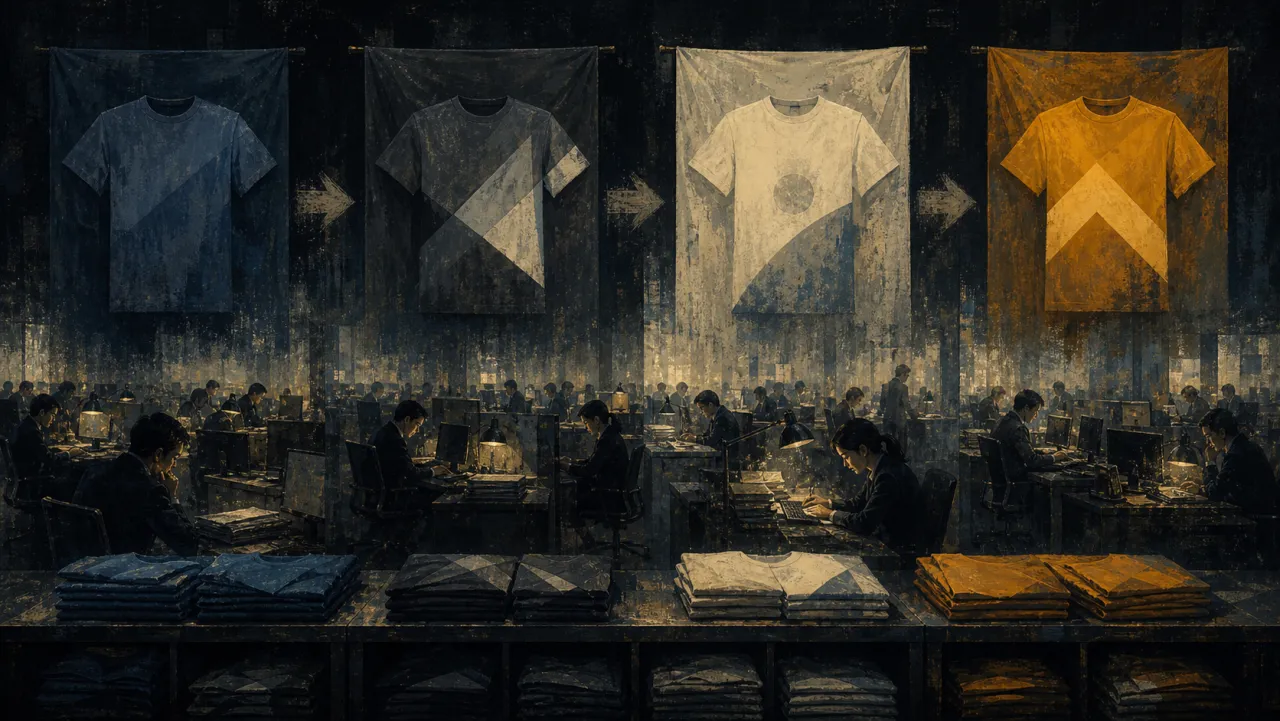
The first T-shirt said "Digital First" in white letters across a blue background. It belonged to the first transformation leader, a man who spoke quickly, loved hackathons, and believed every problem became smaller once an app was placed near it.
For six months, everyone said digital first.
Then he left.
The second T-shirt was black and said "Customer at the Center." The new leader arrived from consulting and disliked the word digital unless it was attached to experience. Workshops changed shape. Journey maps appeared on walls. The organization learned to say pain point with empathy.
For nine months, everyone put the customer at the center.
Then she left.
The third T-shirt was gray and said "Data Wins." This leader loved dashboards, governance, and sentences that began with "What does the data tell us?" People who had spent years ignoring data now requested data before making decisions they had already made.
For eleven months, data won.
Then he was promoted.
The fourth T-shirt was white and said "One Team, One Future." By then, Nhan had become careful with slogans. He wore the shirt at town hall, smiled for the group photo, and placed it beside the others at home.
Each leader brought energy. Each leader was sincere. Each leader saw a real problem the previous era had underweighted. The tragedy was not that the slogans were false.
The tragedy was that they were all partly true.
The organization learned to adapt.
When the slogan changed, decks changed. Initiative names changed. Old work was relabeled. Digital first became customer journey enablement. Customer journey enablement became data-led experience. Data-led experience became one-team operating model.
The same projects survived by changing clothes.
Nhan became fluent in translation. He could take an old initiative and make it sound native to the new era within an afternoon. This was considered a valuable skill.
At first he felt cynical. Later he understood it as institutional survival.
Organizations do not reset every time a leader changes. They compost. Old ideas decompose into new language. Some nutrients remain. Some smell never fully leaves.
One day, a junior colleague found the stack of old shirts during an office cleanup event.
"Should we throw these away?"
Nhan looked at them: blue, black, gray, white. Four eras folded into cotton.
"No," he said. "Keep one box."
"For what?"
"Memory."
The colleague laughed, thinking he was joking.
He was not.
Without memory, every new slogan feels like a beginning. With memory, you can hear the echo. You can ask what is genuinely new and what is simply returning with better typography.
At the next town hall, the newest leader spoke about focus, discipline, and execution. The words were good. The applause was real enough.
Nhan clapped too.
He had learned that cynicism is easy and not very useful. Some leaders do move the organization. Some slogans help people coordinate. A T-shirt can be silly and still mark a moment when people briefly wanted the same thing.
But he also knew to watch what stayed after the shirts faded.
Did a process change?
Did a decision right move?
Did a customer wait less?
Did a team stop doing pointless work?
Everything else was fabric.
That evening, Nhan added the new shirt to the stack.
Five eras now.
The wardrobe was becoming an archive.